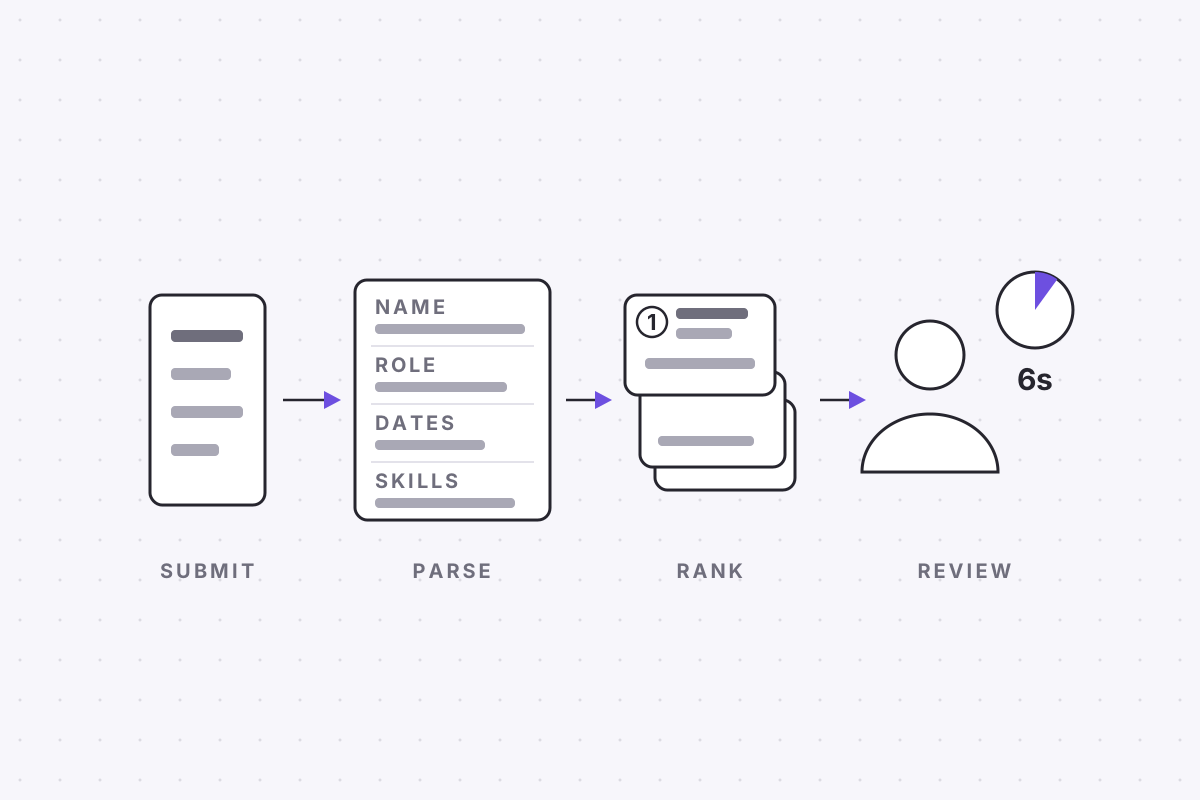
Recruiters don't read resumes. They search them.
Once you apply, you're a database record. Recruiters retrieve you with the posting's exact words. Write for the query, not just the reader.


The most persistent misunderstanding about resume keywords is that they exist to please a machine. They do not. They exist because, on the other side of every job posting, a recruiter is typing terms into a search box, and your resume either contains those terms or it does not.
We walked through the full pipeline in what happens in the six seconds after you hit apply. The short version is that once your file is parsed, you exist as a searchable record in a database. Resume keywords are simply the strings that decide whether that record is ever retrieved. Seen that way, the whole topic stops being about tricking software and starts being about matching a query.
The database behind every job posting
A live posting collects applicants faster than anyone can read them, and recruiters typically carry many roles at once. So they do what anyone with a large database does: they search it. An ATS search runs keyword queries and boolean filters against the parsed text of every candidate record, the way a lawyer searches case law rather than reading every judgment ever written.
ATS keywords are not limited to skills either. Recruiters filter on job titles, locations, employers, qualifications and years of experience, all of which are fields in your parsed record. And the searching does not stop when a role closes. When a new role opens, recruiters run queries across their whole existing database, which means the keywords in an application you sent months ago can surface you for a job that did not exist when you wrote them.
This retrieval model has a hard implication. If your record does not match the query, you were not rejected in any meaningful sense. You were never retrieved. Nobody weighed your experience and found it wanting. The search simply returned other people, and the process moved on without you.
Understanding that distinction changes where you spend effort. Polishing prose helps the reader you eventually get. Keywords determine whether you get a reader at all.
Exact-match thinking: why your synonym never gets queried
Recruiters tend to search the posting's own vocabulary, for an unglamorous reason: they wrote the posting, or sat with the hiring manager who did. The words in the job description are the words in their head when they build the query.
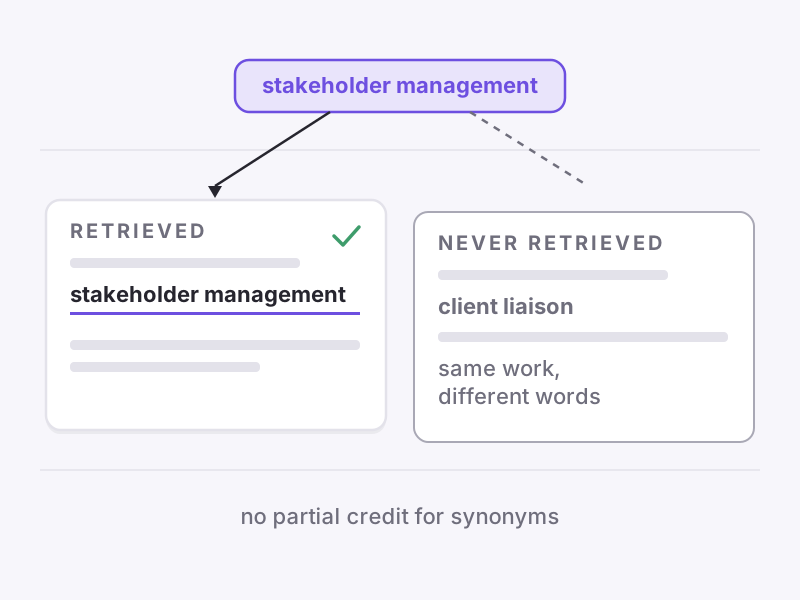
So if the posting says stakeholder management and your resume says client liaison, you may be describing identical work, but the search for stakeholder management will never return you. The same goes for tools and abbreviations. A recruiter searching PMP will not find "certified project professional", and one searching Kubernetes may not think to try "container orchestration".
Abbreviations deserve their own rule. You cannot know if the query will use the acronym or the full phrase, so give the record both, written once as Search Engine Optimisation (SEO) or Registered Nurse (RN). The same logic runs across markets: a Programme Manager in London is a Program Manager in Toronto, and the record that carries the posting's spelling wins the query.
Some systems attempt a little synonym expansion, but coverage is patchy and you have no way to know what any given system maps. The only safe assumption is exact match. Tailoring, at its core, means translating your genuine experience into the posting's dialect, without inventing anything in the process.
Mining the job description for the words that matter
The job description is the search query written out in advance, which makes learning how to tailor a resume mostly a reading exercise. Pulling resume keywords from a job description takes about fifteen minutes done properly.
- Collect the hard skills, tools and platforms named explicitly, because concrete nouns are what recruiters actually type into the search box.
- Include the job title itself, since recruiters routinely search for people who already hold the title they are hiring for.
- Note certifications and qualifications, and use the variant your market recognises, since a UK employer searches ACCA where a US one searches CPA.
- Watch for repetition, because a term that appears three times in one posting is almost certainly a term the hiring manager cares about.
Do this against the posting you are actually answering, not a generic version of the role. Two postings for the same title can weight entirely different terms, and the query will be built from the one sitting in front of the recruiter.
Then separate requirements from furniture. Phrases like excellent communication skills appear in every posting and nobody searches them. A named tool, a certification, a methodology or a domain term is a plausible query. Furniture is not.
Where resume keywords live: skills section vs woven into experience
Placement matters more than most advice admits. A keyword attached to an achievement reads stronger than the same word sitting alone in a skills list, and that is true for both the software and the human. Some systems weight frequency and recency, so a term appearing in your current role scores higher than the same term buried in a job you left years ago.
The practical pattern is to use both locations for different jobs. The skills section works as an index: a clean, scannable list that guarantees the term exists in your record. The experience section supplies the evidence: the same term inside a bullet point, doing visible work, with a result attached. A record that says Terraform in a list and then shows Terraform provisioning a production environment two lines later satisfies the query and survives the human read that follows it.
What does not work is scattering terms with no support. A skills list of forty entries with no appearances anywhere else in the record reads as padding, and screeners have seen thousands of them.
Recency cuts both ways, so use it deliberately. If your strongest match for a role sits in a job two positions back, consider whether the same skill honestly belongs in the description of your current work. If it does, say so there. If it does not, the posting may be aimed at a slightly different candidate, which is worth knowing before you spend an evening on the application.
Keyword stuffing: the trick that stopped working
The old trick was white text: paste the entire job description into the document in a font the eye cannot see, and let the machine count the matches. It fails today on mechanism, not morality. Recruiters screen the parsed record, and parsing strips all formatting, including colour. Your invisible paragraph surfaces as a block of visible gibberish at the bottom of your profile.
Repeating a keyword nine times fares no better. The parsed record makes repetition obvious, and the human in the loop, the person examined in who actually rejected your resume, discards records that look gamed. Stuffing does not beat the filter. It converts a possible keep into a certain discard. The same fate awaits the modern variants, keyword blocks in tiny fonts or crammed into margins, because anything the parser can read, the recruiter can see.
Checking coverage with a match score
The honest version of keyword matching is coverage checking: put your resume next to the posting and see which terms are present, which are missing, and which are present but poorly placed. A match score does that arithmetic for you. ApplyHustle's AI Match Score reads both documents and returns the overlap along with the specific gaps, which beats squinting at two windows.
The point is not to chase a perfect number. Gaps come in two kinds. Vocabulary gaps are fixable in minutes, because you already do the work and merely named it differently. Real gaps, skills you do not have, are information of a different sort, the kind that feeds the decision covered in whether you should even apply. Run the check before you apply rather than after the silence, because coverage is only useful while you can still act on it.
Keywords are not a trick to be played on software. They are the shared language between a posting and a record, and the candidates who get retrieved are simply the ones who bothered to speak it.