Tailoring your resume without rewriting it every time
Per-job tailoring works, but not if it costs you an hour per application. The trick is deciding what is fixed and what is variable.

Tailoring a resume to the posting measurably improves response rates, and almost nobody disputes it. The problem is arithmetic. If a tailored application costs forty-five minutes, you will produce four of them, watch an evening disappear, and quietly go back to sending the generic version. The candidates who keep tailoring past week two are not more disciplined than you. They are running a cheaper workflow.
The expensive version fails because it treats every application as a writing task, opened from a blank page or, worse, from last night's version. The cheap version treats each application as a selection task, and the split between the two is decided once, in advance, before any particular job is on the screen.
Decide once what is fixed
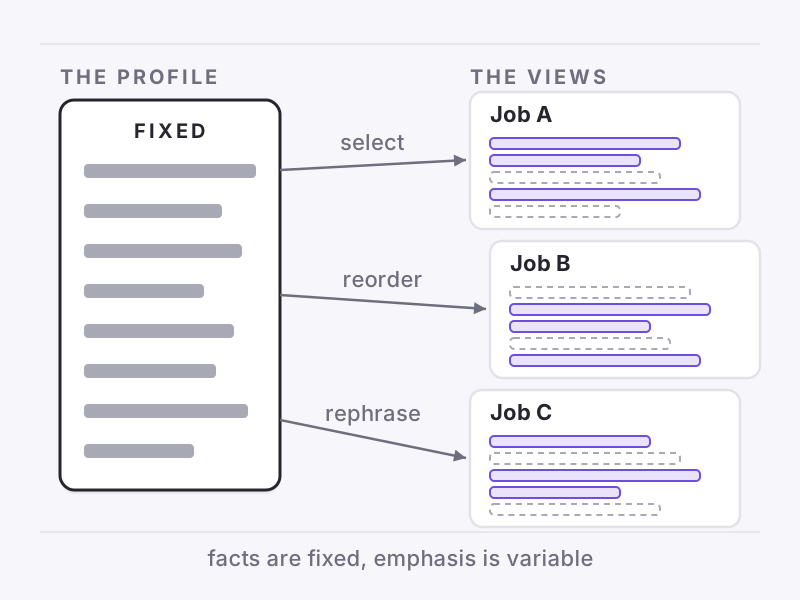
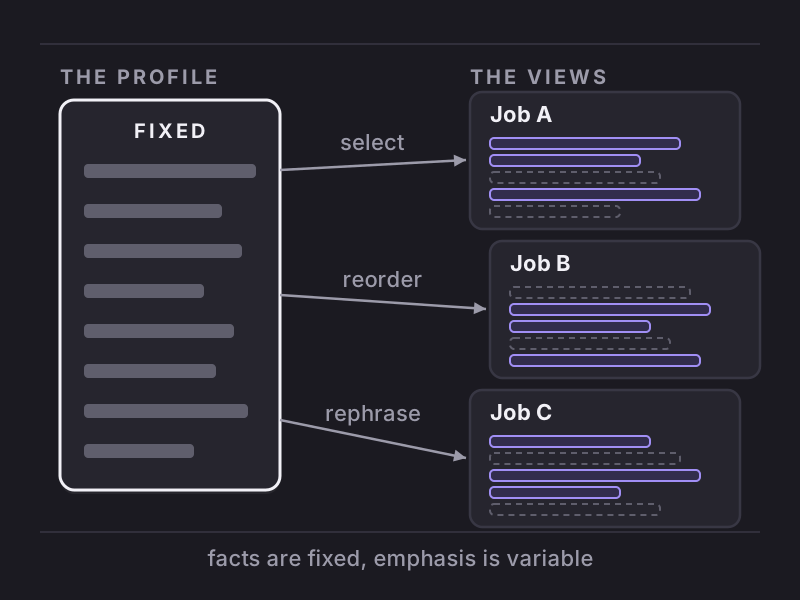
Most of a resume never changes between applications, and pretending otherwise is where the forty-five minutes goes. Your employers, your dates, your education and the factual content of what you built are settled. What changes per job is emphasis, and emphasis is a short, finite list. Drawing that boundary in advance is the whole trick, because a decision made once is free on every application that follows.
- Fixed: employers, dates, qualifications and the underlying facts of every achievement, written once, checked once, and never relitigated at ten in the evening.
- Variable: which bullets appear at all, because a posting about reliability deserves different evidence than a posting about speed of delivery.
- Variable: the order of bullets inside each role, since the first line under your current job is the most-read sentence on the page.
- Variable: the summary line and the vocabulary, which should answer this posting rather than the market in general.
A profile as the source of truth
The workflow that makes selection possible keeps one master version, deliberately longer than anything you would send. Every role, every project, every bullet you have ever written, including two or three phrasings of the same achievement aimed at different kinds of posting. It is not a resume. It is the warehouse a resume is picked from.
With the warehouse in place, a new application starts from abundance instead of a blank page. You read the posting, pick the twelve bullets that answer it, order them and export. Nothing gets composed under deadline pressure, and nothing you wrote well in March has to be reinvented worse in July. ApplyHustle is built on the same principle: your profile holds the complete record, and each resume is a view over it rather than a fresh document.
The warehouse also stops a quieter failure: version rot. When every application edits the live document, each hurried change degrades it slightly, and the resume you are sending in month three is worse than the one you started with. A fixed source of truth cannot rot, because sent versions are outputs, not the master.
The fifteen-minute routine
With fixed and variable separated, tailoring settles into a routine you can put a clock on. Five minutes reading the posting and marking the terms it repeats, because a phrase that appears three times is a phrase the hiring manager cares about. Five minutes selecting and ordering bullets against those terms. Five minutes on the summary line and the vocabulary, then export and send.
Hold yourself to the clock, because overruns are diagnostic. If the selection step keeps stalling, the warehouse is missing evidence you repeatedly need, which is a one-time fix rather than a per-job cost. If the reading step stalls, you are not sure the role fits at all, and that is a targeting question wearing a tailoring costume.
The vocabulary pass is the only writing in the routine, and it has a hard boundary. If the posting says data pipelines and your resume says ETL workflows, adopt their term, because their term is what gets typed into the search box; the retrieval mechanics behind that are covered in recruiters don't read resumes. If their term describes work you have not done, leave it out. The gap will surface in the first interview, where it costs far more than it saved here.
Tailoring is selection, not composition. The moment you are writing new sentences for one application, the workflow has already failed.
Keep the version you sent
One unglamorous habit completes the loop: save the exact file you sent, per application, named so you can find it in five seconds. Interviews are run off the version the company holds, and that is the one you tailored six weeks ago, not whatever is currently on your desktop. Being quoted a bullet you no longer remember writing is an avoidable way to open a screening call.
The saved versions also enforce an honest limit on variation. If two of them diverge so far that you could not say what a given company was told, the tailoring has drifted from emphasis into fiction, and an interviewer will find the seam. Selection from a truthful warehouse cannot drift that way, which is half the argument for the warehouse.
When tailoring is not the problem
There is a failure pattern that no amount of tailoring fixes, and it wastes more time than clumsy tailoring ever did. If dozens of well-aimed, carefully tailored applications produce nothing at all, the document is probably not the problem. The shortlist is.
Wrong seniority, wrong location, roles that require work authorisation you do not hold, or a file that parses so badly the tailoring never reaches a human: each of these makes per-job polish irrelevant, and each needs a different fix from more polishing. Run a match score against a specific posting before you tailor for it. Vocabulary gaps close in minutes; real skill gaps are information about targeting, not an editing task.
Tailoring earns its reputation only inside a sane shortlist. Fix the targeting, build the warehouse once, and the per-job cost falls to about fifteen minutes, which is the only price at which anyone keeps paying it.