

A job-search strategy that accounts for sponsorship
For international candidates the hard part is rarely the resume. It is the weeks spent on roles that were never open to you.

If you need visa sponsorship, the expensive mistake in a job search is not a weak application. It is a strong application to an employer who was never going to sponsor anyone, repeated in good faith for three months. Worse, the rejection never arrives as a rejection. It arrives as silence, indistinguishable from every other silence, so the lesson never gets learned.
The fix is structural rather than motivational. A sponsored candidate's funnel contains a gate that domestic candidates do not have, and most people encounter it at the end of the process, where it wastes everything upstream. Moved to the front, the same gate becomes a targeting tool, and the whole search changes shape.
Qualify the employer before you write a word
In several countries, whether an employer can sponsor at all is public information. The United Kingdom publishes a register of licensed sponsors, and a company not on it cannot sponsor a Skilled Worker visa regardless of what a recruiter hopes. Australia requires a business to hold approved sponsor status before it nominates anyone. In the United States, public filing data shows which employers have actually petitioned for work visas, in which roles, and how often.
Other markets place the gate elsewhere, which is the part global advice usually misses. Germany has no sponsor licence to look up; the practical questions are whether the salary clears the EU Blue Card threshold and whether the company has taken a foreign hire through the process before. In Canada, much depends on whether an employer will undertake a labour market assessment, unless your existing permit makes one unnecessary. The paperwork differs, but every market has a checkable fact, and checking it costs minutes where an application costs a week.
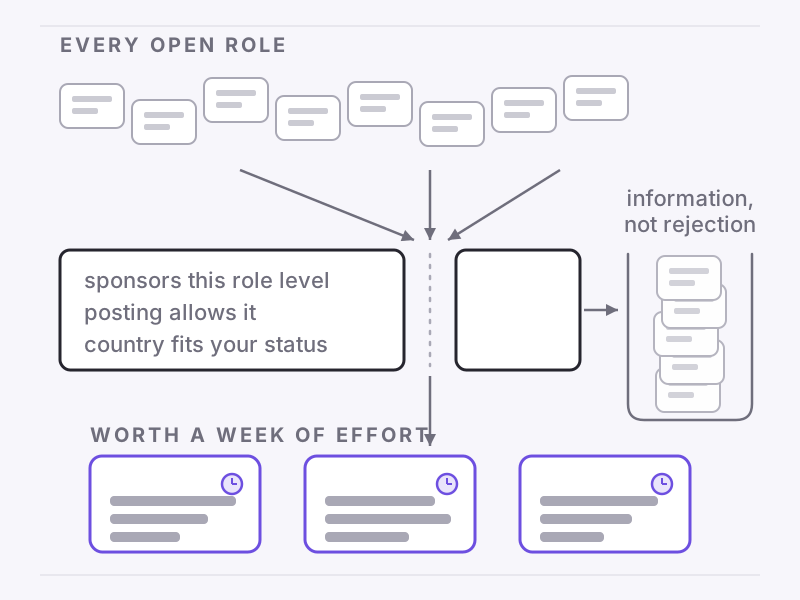
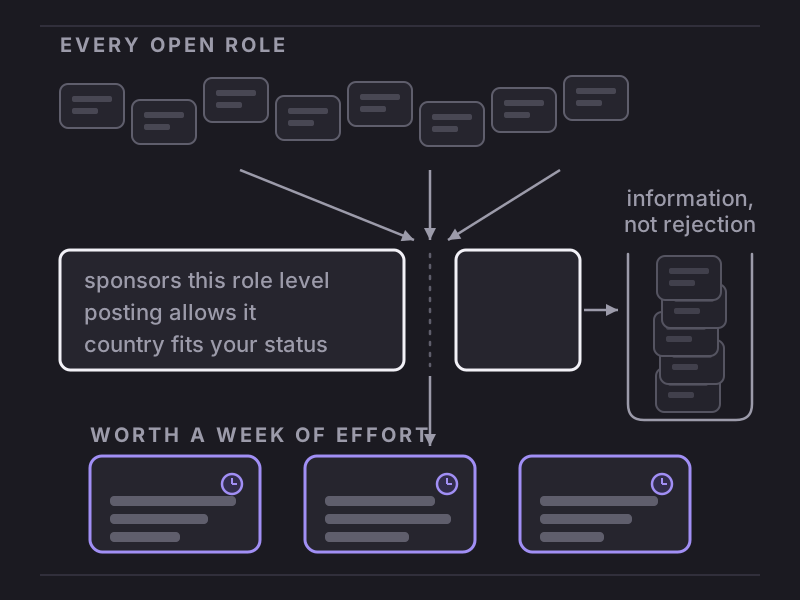
Company-level history is necessary but not sufficient. A firm that sponsors senior engineers may never sponsor a graduate analyst, so look for sponsorship at your level and in your function, not just anywhere in the organisation. Job titles in the public data, and current visa-holding employees findable on LinkedIn, answer that more honestly than a careers page ever will.
Read the posting like a form, because it is one
Postings tell you more than people credit. A line such as must have the right to work without sponsorship is not an obstacle to be overcome with a brilliant cover letter. It is usually wired into the application form as a knockout question, and the wrong answer closes the application before a human reads a word of it.
Treat that line as information, not rejection. Every posting it removes from your list hands back the week you would have spent on it, and the honest arithmetic of a sponsored search is that a shorter real list beats a longer imaginary one every time.
- Check the public record where the country keeps one: the UK sponsor register, Australian approved sponsor status, or United States filing data broken down by employer and job title.
- Check the posting and the application form for authorisation language before investing anything, because a knockout question decides faster than any recruiter does.
- Check for sponsorship at your level and in your function, since a company that sponsors principal engineers has told you nothing about its graduate intake.
- Check what your current permit already covers, because a role you can hold today without sponsorship belongs in a different and much easier pile.
State your status in one plain line
Vagueness about work authorisation reads as risk even when the facts underneath are fine. The recruiter is not judging your character; they are judging whether a hiring process will complete on schedule. A candidate who makes them do the immigration research themselves gets a conservative answer.
A recruiter who has to work out your visa situation for themselves will assume the least convenient version of it.
So do the working for them, in one line: what you hold now, until when, and what, if anything, an employer would need to do and by what date. A candidate with two years of post-study work rights who needs nothing from the employer until year two is an easy decision. The same person, described only as needs sponsorship, is a hard one. The post-study permits across the major markets, the UK Graduate route, Canada's post-graduation work permit, Australia's temporary graduate visa, exist to make you hireable immediately, and a vague sentence buries that advantage.
Compete on timing, not volume
A sponsored search runs on a smaller pool of viable employers, which changes what winning looks like. When you cannot outnumber the field, be earlier than it. An application landing in the first days of a posting is read by someone still forming their picture of the market. The same application arriving after two hundred others is read against a shortlist that already exists.
Timing also runs on annual clocks that domestic candidates never think about. Graduate schemes in the UK open and close in fixed windows. The main United States work visa allocates places through an annual registration, which means an offer has to exist months before the start date it enables, and some quotas elsewhere reset yearly too. Work backwards from those dates and you find that applications sent in the wrong month are quietly worth less, whatever their quality.
This is the trade the whole strategy makes: fewer applications, sent faster, to employers who qualified. ApplyHustle's job feed is built for the fast part, surfacing roles within hours of posting rather than weeks after, which is the window in which arriving early is still possible.
The short list is the strategy
None of this is resume advice, deliberately. Qualify employers before applying, read the posting as the legal document it quietly is, state your status so nobody has to guess it, and spend your speed on the list that survives. Each step makes the list shorter and the search better, in that order.
The discomfort of the short list is the point of the short list. Every name still on it is an employer where your application can actually complete, and thirty of those are worth more than three hundred of the other kind.