Skip to content
Cover Letter Studio

The letter you are sendingis the letter everyone is sending.

Score the one you have been reusing, rewrite it so it stops reading like a template, or write a new one from your profile, your resume and the posting. Ten weighted rows out of 100, and the two worth the most are the two a template cannot fake.

  • 10 rowsscored, weights published
  • 40 of 100personalisation and evidence
  • 3 of 100formatting, not your layout
Where the points actually are

Forty of the hundred pointsgo to things a template cannot fake.

Personalisation and evidence carry twenty points each. Formatting carries three. That ordering is the whole reason a tidy, well-structured, entirely generic letter scores in the fifties. It is also why the fix is never a nicer layout.

40 points · The two that decide it60 points · Everything else, together
  • Personalisation20
  • Proof & evidence20
  • Skills ↔ JD match15
  • Tone & register12
  • Opening hook10
  • Closing8
  • Spelling & language5
  • Contact frame5
  • Structure & ATS3
  • Length2

10 rows · 100 points · Weights are the engine’s, identical on every run and in every market.

The breakdown is the score

There is no ceiling and no curve between the rows and the headline. Add the ten numbers up and you get the number at the top. That is the only reason arguing with it is possible.

No job description costs exactly eight

Five from skills match, three from evidence. It comes off those two rows and nothing else, and it is handed straight back the moment you paste a posting in. Nothing else moves.

The same ten rows in six markets

The weights do not change between the US, the UK, Canada, Australia, Germany and India. What changes is the spelling standard and the date format, and those are set before a word is written.

The three tools

Score it, fix it,or never start from a blank page again.

One tab each in the app, one engine underneath all three. The number the checker gives you is the number the other two are working against, so a rewrite that claims +30 is claiming it on the same scale.

01

Cover Letter Score

You keep reusing one letter and have no idea whether it does anything.

Paste it or upload it and get the ten rows back with the points you earned in each. The breakdown is the score; there is no rounding and no ceiling between them.

What you get: Ten scored rows out of 100 with every weight published, and the two rows costing you the most named first. The spelling conventions of the market you are applying in are never penalised.

  • Ten rows, published weightsThe same ten in every market, so it means one thing
  • The headline is the sumNo caps, no curve. The ten rows add up to the score
  • No job description costs exactly 8Taken from skills match and evidence only, and named as such
  • It says when it cannot scoreA scan with no text layer is named, not quietly scored
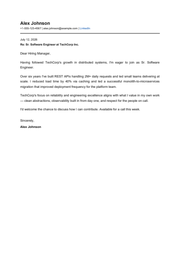
Score a letter
02

Cover Letter Redesign

The letter is honest. It just sounds like everybody else’s.

The rewrite works on the two rows that carry the most weight: what makes this letter about this employer, and what backs it up. Your claims are kept; the filler around them is not.

What you get: The same letter rewritten so it stops reading like a template, scored before and after on the same ten rows. Nothing is invented — only what you already gave it is used.

  • Eleven phrases banned by name“I am writing to apply”, “team player” and nine more
  • Nothing is inventedNo achievement, metric, employer or date you did not supply
  • Scored before and afterSame ten rows both times, so the gain is a number, not a feeling
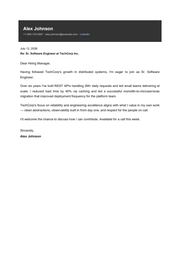
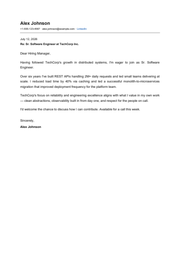
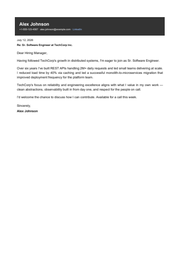
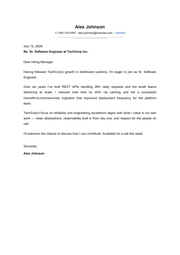
  • Five layoutsClassic, Executive, Modern, Compact and Elegant
Redesign a letter
03

Generate Cover Letter

Forty applications this month. Forty letters is not going to happen.

Written from three inputs you already have: your profile, your resume and the posting. The specifics come from your own record, not from a template with a company name dropped in.

What you get: A letter written from your profile, your resume and the posting you paste in, scored on arrival so you start from a number rather than a blank page.

  • Three inputs, one draftProfile, resume and posting, not another form to fill in
  • Written in the market’s standardSpelling and date format fixed before the first word
  • Acronyms expanded onceFull form first, then the short one, only where you use it
  • A draft, not a send buttonIt comes back scored and editable, because it is still yours
Generate a letter
What it refuses to do

An AI letter gives itself awayin about eleven phrases.

So the writing rules name them and forbid them. This is the list exactly as it appears in the engine, not a summary of it.

Banned openers and filler

Every one of these is refused outright. The rules also require something specific about this employer and this role, because generic praise is the single clearest signal of an untargeted letter.

  • I am writing to apply
  • I am excited to apply
  • team player
  • hardworking
  • detail-oriented
  • passionate about
  • results-driven
  • synergy
  • dynamic
  • cutting-edge
  • innovative solutions

It will not invent anything

“Never invent an achievement, metric, employer, or date. Use only what the candidate gave you.” That line is in the writing contract, and it is why a rewrite can raise your score without putting anything in your letter you would have to defend in an interview.

It will tell you not to send one

Some employers do not accept cover letters at all. Some public-sector roles want key selection criteria instead of a letter. The report says so and stops, rather than grading a document nobody is going to open.

It writes to be read by a person

Uniform, evenly weighted paragraphs are what a generated letter looks like, and hiring teams now run detectors. So sentence length varies on purpose, and acronyms are expanded on first use, but only for terms your own background already uses.

Spelling and dates are locked before the first word

Write “organization” in one paragraph and “organisation” in the next and the letter reads as copy-paste. The engine treats a mixed standard as a critical error, so the standard is fixed by market up front rather than corrected afterwards.

  • United StatesUS spellingMarch 7, 2026
  • United KingdomBritish spelling7 March 2026
  • CanadaUS spelling7 March 2026
  • AustraliaBritish spelling7 March 2026
  • GermanyBritish spelling7 March 2026
  • IndiaUS spelling7 March 2026

The ten scoring weights are the same in all six. Only the language conventions move.

Before you write another one

The questions worth asking

Do cover letters even get read?
Not always, and the tool says when. Some employers skip them entirely, and some public-sector roles want key selection criteria instead. The report tells you that rather than scoring a document nobody will open.
Won’t an AI letter be obvious?
The eleven phrases that give it away are banned by name, sentence length is varied on purpose because hiring teams run detectors, and the rules require something specific about this employer before anything else.
What is it actually scoring?
Ten weighted rows totalling 100. Personalisation and evidence carry 20 each, skills-to-posting match 15, tone 12, the opening 10. Formatting carries 3. It is almost never what is wrong.
Do I need the job description?
No, but without one you lose exactly 8 points: 5 from skills match and 3 from evidence. The report names both. Paste a posting in and they come straight back. Nothing else in the score moves.
Does it handle British spelling?
The spelling standard and the date format are set from your market before a word is written, across all six markets. Canada, for instance, takes US spelling with a day-first date.
What does it cost to find out?
The free plan includes 20 credits a month, and every AI tool draws from that same allowance rather than from a separate quota per tool. No card to start.

Score the letter you have been reusing.It is faster than writing another one.

You will get ten numbers and the two that are costing you the most. If the letter is already strong, that takes a minute to confirm, and you can stop wondering whether the problem was ever the letter.

Score a cover letter
  • Free tier, no card required
  • Ten rows, no hidden category